
INTERVENTIONAL CARDIOLOGY DIAGNOSTICS
Transradial Coronary Angiography (CAG) in Varanasi
High-precision diagnostic imaging via the wrist to detect coronary artery disease, narrowing, and blockages with minimal discomfort, low bleeding risk, and same-day recovery.
Understanding Coronary Angiography (CAG)
Coronary Angiography (CAG) is an established diagnostic fluoroscopic procedure used to visualize blood flow through the coronary arteries that deliver oxygen-rich blood to the myocardium (heart muscle). By introducing a specialized radio-opaque contrast agent under continuous X-ray monitoring, the test identifies the presence, severity, and exact anatomical location of atherosclerotic plaque build-up or artery narrowings.
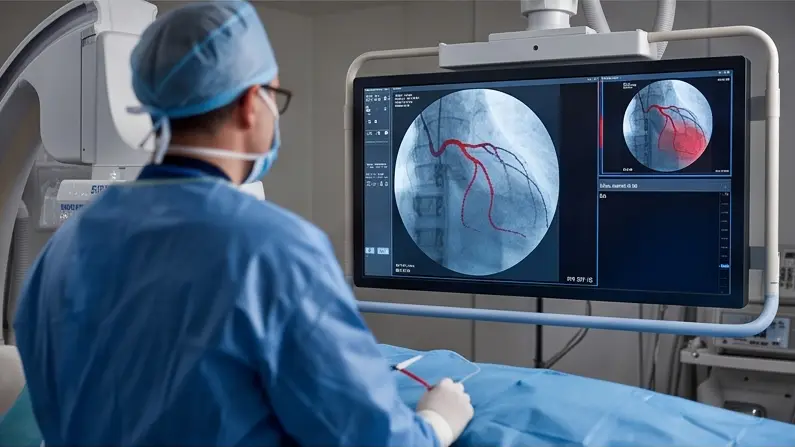
At Star Hospital, Akhri Bypass (Chunar Road), Varanasi, this diagnostic evaluation is conducted by Dr. Gopal Krishna Rai (MD, DM Cardiology, FSCAI) using a flat-panel digital Cath Lab suite.
The Transradial Route: Why Wrist Access is Preferred
Performing coronary angiography via the radial artery in the wrist provides significant clinical advantages over the traditional femoral (groin) puncture, ensuring faster recovery and minimal procedural discomfort.
1. Minimal Bleeding Risk
The superficial position of the radial artery against bone allows direct, effective compression, significantly reducing the risk of vascular puncture-site hematoma or bleeding.
2. Immediate Mobilization
Unlike femoral access requiring 6 to 8 hours of strict flat bed rest, radial patients can sit up immediately, walk comfortably, and eat light meals shortly after the test.
3. Day-Care Discharge
Diagnostic radial angiography is performed routinely as a day-care procedure, enabling most patients to return home safely within 2 to 4 hours of post-procedure observation.
4. High Diagnostic Accuracy
Advanced digital flat-panel fluoroscopy provides sharp, multi-angle views of coronary artery branches to guide medical therapy or immediate angioplasty planning.
Book Cardiac Evaluation
Consult Dr. Gopal Krishna Rai for transradial angiography evaluation, second opinions on coronary blockages, and non-invasive cardiac testing at Star Hospital, Varanasi.
OPD & Emergency Hours
Monday – Saturday:
10:00 AM – 5:00 PM
Sunday:
By Appointment / Emergency Only
CLINICAL STANDARDS IN INTERVENTIONAL CARDIOLOGY
Why Choose Dr. Gopal Krishna Rai for Coronary Angiography?
Performing high-resolution transradial diagnostic angiography within a modern digital Cath Lab, focused on accurate blockage detection, minimal vascular trauma, and rapid same-day recovery in Varanasi
Transradial Wrist Access
Routine use of the radial artery route at the wrist reduces puncture-site bleeding risk, eliminates prolonged flat bed rest, and enhances overall procedural comfort
Flat-Panel Digital Cath Lab
Clear fluoroscopic cine imaging to map multi-vessel disease, bifurcation lesions, and calcified stenosis while keeping radiation and contrast dye volumes optimized.
Comprehensive Care & Support
Detailed post-procedure review of angiogram recordings, transparent treatment counseling, and dedicated scheme assistance under Ayushman Bharat (PM-JAY)
FAQ
Frequently Asked Questions About Coronary Angiography (CAG)
Objective medical details regarding procedure preparation, radial wrist access, safety measures, and recovery expectations in Varanasi.
Coronary angiography (CAG) is a fluoroscopic diagnostic procedure that uses specialized radiographic contrast dye to map blood flow within the coronary arteries. It identifies the exact location, length, and degree of arterial blockages causing angina or acute coronary symptoms.
The procedure is performed under local anesthesia at the puncture site (wrist or groin) so patients feel minimal discomfort. Minor sensations of warmth may occur during dye injection. Performed in a digital Cath Lab under strict hemodynamic monitoring, coronary angiography is considered a routine and low-risk procedure.
Transradial access uses the radial artery at the wrist. This technique significantly lowers the chance of access-site bleeding or hematoma, removes the need for flat bed rest, and allows most patients to sit upright immediately and walk within hours.
A routine diagnostic transradial angiogram is typically performed as a day-care procedure. Following 2 to 4 hours of post-procedure observation and verification of radial puncture hemostasis, stable patients can be safely discharged home the same day.
Patients generally require a short fast of 3 to 4 hours prior to the test. Basic blood work—particularly kidney function testing (Serum Creatinine) to confirm contrast clearance safety—along with baseline ECG and blood pressure assessments, must be completed beforehand.

- Star Hospital,
- Akhari Bypass, Chunar Road, Varanasi, Uttar Pradesh
- contact@drgopalkrishnarai.com
- +91 8280846997
Cardiac Treatments
Quick Links
- About Dr. Gopal Krishna Rai
- Cath Lab & Emergency PCI
- Ayushman & Cashless TPA
- OPD Timings
- Patient Reviews
- Contact & Clinic Location
Priority Heart Health Updates
Enter your email to receive preventive heart tips, lifestyle advice, and direct updates on OPD consultation schedules.